If your tool has no dedicated guide but accepts a custom Base URL and API Key, use the values below.

Configuration Reference

MiniMax exposes two protocols. Pick whichever your tool supports — most modern tools support at least one.

OpenAI-Compatible Protocol

Anthropic-Compatible Protocol

Which Protocol Should I Pick?

Cherry Studio

Cherry Studio is an open-source desktop client supporting 50+ LLM providers, with built-in MCP servers and 300+ assistants.
1

Install

Install Cherry Studio per the official docs.
2

Add MiniMax provider

Open Cherry Studio → click Choose other Providers → search MiniMax, then pick MiniMax.
3

Enter API Key

Enter your Subscription Key (the API Host is prefilled), then click Check to verify.
4

Pick the model

Select MiniMax-M3.1-Flash-Preview from the model list.

Chatbox

Chatbox is a free, open-source, cross-platform AI client supporting advanced LLMs, custom API keys (BYOK), and AI agents across desktop, mobile, and web.
1

Install Chatbox

Install Chatbox per the official docs.
2

Add MiniMax provider

Open Chatbox → click Settings → click Model Provider → click Add → search MiniMax, then pick MiniMax Global.
3

Enter API Key

Enter your Subscription Key (the API Host is prefilled), then click Check next to API Key to verify the connection.
4

Pick the model

Select MiniMax-M3.1-Flash-Preview from the model list.

Xcode

Xcode is Apple’s official IDE for macOS, iOS, iPadOS, watchOS, and visionOS, now with built-in Coding Intelligence.
1

Install Xcode

Install Xcode 26 or later from the Mac App Store.
2

Add a Model Provider

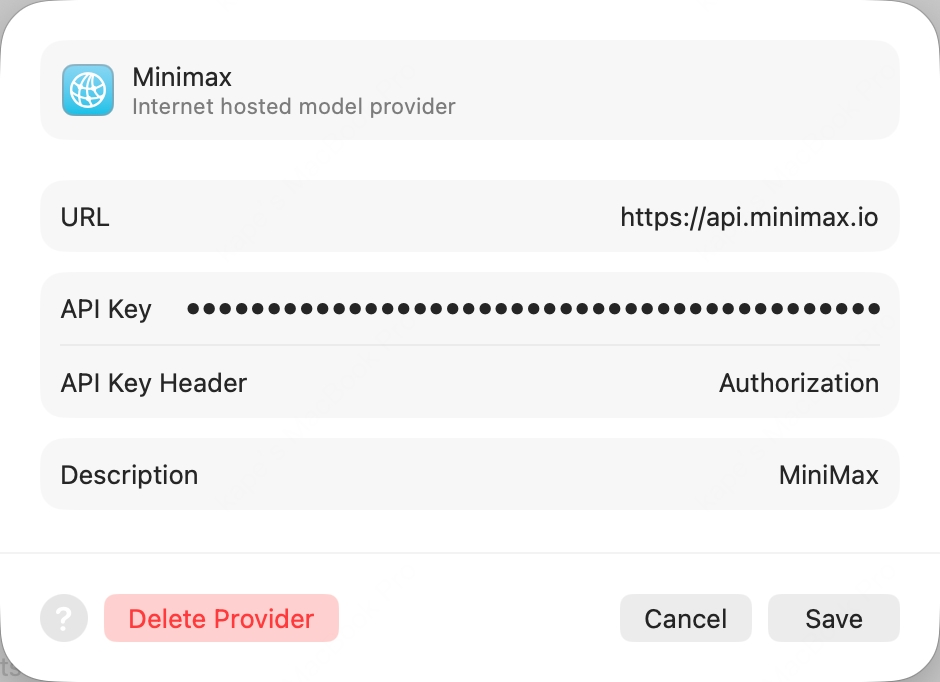
Open Xcode → top menu Xcode → Settings → Intelligence → Add a Model Provider, choose the Internet Hosted tab, and fill in:
  • URL: https://api.minimax.io (bare host, no path)
  • API Key Header: Authorization (override the default x-api-key)
  • API Key: Bearer <your Subscription Key> (the word Bearer, a single space, then your sk-cp-… key — get one here)
  • Description: MiniMax (any value)
Xcode Add a Model Provider dialog
3

Enable the model

Click Add. Back in the Intelligence pane, open the new MiniMax provider and enable MiniMax-M3.1-Flash-Preview.
4

Start chatting

Open any project, press ⌘+0 to bring up the Coding Assistant, click the edit icon at the top-left to pick MiniMax-M3.1-Flash-Preview.

Kilo Code

Kilo Code is an open-source AI coding agent for VS Code, supporting multiple LLM providers and MCP servers.
First clear the ANTHROPIC_AUTH_TOKEN and ANTHROPIC_BASE_URL env vars — otherwise they will override the configuration.
1

Install the extension

Search Kilo Code in the VS Code Extensions panel and install.
2

Configure MiniMax provider

Open Kilo Code → Settings:
  • API Provider = MiniMax
  • MiniMax Entrypoint = api.minimax.io
  • MiniMax API Key = your Subscription Key
  • Model = MiniMax-M3.1-Flash-Preview
Click Save then Done.

Zed

Zed is an open-source, high-performance multiplayer code editor written in Rust by the Atom creators.
1

Install Zed

Install Zed per the official docs.
2

Add LLM Provider

Settings → LLM Provider → +Add Provider → choose OpenAI, fill:
  • API URL = https://api.minimax.io/v1
  • API Key = from M Plan
  • Model Name = MiniMax-M3.1-Flash-Preview
3

Re-confirm API Key

Click Save Provider. Then back in the LLM Provider list, click the new MiniMax entry, re-enter the API Key and press Enter to confirm.
4

Pick the model

Return to the agent panel, click Select a Model at the bottom-right and pick MiniMax-M3.1-Flash-Preview.

Grok CLI

Grok CLI is an open-source terminal coding agent that connects to xAI’s Grok and OpenAI-compatible providers.
Not recommended for Agent workflows — use Claude Code or Cursor for best results.
First clear the OPENAI_API_KEY and OPENAI_BASE_URL env vars.
Run:
Select Grok CLI. If it is missing, keep Grok CLI selected in the second multi-select. The wizard runs the official Grok Build installer, checks grok --version, preserves unrelated settings, and adds a MiniMax model to ~/.grok/config.toml.Run grok when setup finishes.

Droid

Droid is Factory’s official terminal coding agent that integrates with IDEs and developer collaboration tools.
First clear the ANTHROPIC_AUTH_TOKEN env var, otherwise it overrides the API Key in the settings file.
1

Install Droid

2

Edit config file

Add the following to customModels in ~/.factory/settings.json:
3

Launch and pick model

Launch droid, then /model and pick MiniMax-M3.1-Flash-Preview.

Qwen Code

Qwen Code is Alibaba’s open-source terminal coding agent optimized for the Qwen model family.
1

Install Qwen Code

Linux / macOS:
Windows (works in both Command Prompt and PowerShell):
2

Launch and pick provider

Run qwen in your terminal. Pick Third-party Providers → MiniMax API Key → region International.
3

Enter API Key

Enter your API Key from M Plan (prefix sk-cp-…) and press Enter.
4

Confirm model IDs

The default model ID should be MiniMax-M3.1-Flash-Preview — press Enter to submit and start chatting.

Open WebUI

Open WebUI is a self-hosted, open-source AI chat platform with offline support, RAG, and multi-model runners.
1

Install Open WebUI

Install via Python pip (requires Python 3.11 to avoid compatibility issues):
2

Create admin account

Open http://localhost:8080 in your browser and follow the prompt to create a local admin account.
3

Add OpenAI Connection

Click the avatar (top-right) → Admin Panel → top Settings tab → left Connections. In the OpenAI row, click ➕ Add Connection, fill:
  • URL: https://api.minimax.io/v1
  • Auth (Bearer mode): your API Key from M Plan (prefix sk-cp-…)
4

Pick the model

Click Save and back in the chat view, pick MiniMax-M3.1-Flash-Preview from the top model selector to start chatting.

nanobot

nanobot is an ultra-lightweight open-source personal AI agent CLI from HKUDS, with chat channels, memory, and MCP support.
1

Install nanobot

2

Initialize

3

Configure MiniMax in one shot

Replace sk-cp-... with your Subscription Key:
4

Launch

OpenHands

OpenHands (formerly OpenDevin) is an open-source AI software-development agent by All-Hands-AI, with TUI, web GUI, and IDE integrations.
1

Install OpenHands

2

Configure MiniMax in one shot

Replace sk-cp-... with your Subscription Key:
3

Launch

LangChain

LangChain is the open-source framework by LangChain Inc. for building LLM-powered applications, with model adapters, retrieval, agents, and tracing.
1

Install

2

Use MiniMax via the OpenAI-compatible adapter

Replace sk-cp-... with your Subscription Key:

TRAE

TRAE is ByteDance’s AI-native IDE with intelligent collaboration and agent automation.

Install and Launch TRAE

1

Download and Install TRAE

Go to TRAE’s website to install TRAE
2

Complete Initial Setup

Click TRAE’s icon to launch it. The following screen appears at TRAE’s first launch
3

Start Setup

Click the Get Started button, TRAE’s setup beginsFor detailed installation steps, please refer to: Trae Setup Guide

Configure MiniMax API

Important: Clear OpenAI Environment Variables Before ConfigurationBefore configuring, ensure you clear the following OpenAI-related environment variables to avoid conflicts with MiniMax API:
  • OPENAI_API_KEY
  • OPENAI_BASE_URL
In TRAE, connect to MiniMax-M3.1-Flash-Preview with your M Plan Subscription Key.
1

Open Settings

At the top right of the side chat box, click Settings icon > Models
2

Select Models Tab

Switch to the Models tab.
3

Add Model

Click the + Add Model button. The Add Model pop-up appearsEnter Configuration Details:
  • Provider: Select MiniMax-Global
  • Model: Select MiniMax-M3.1-Flash-Preview
  • API Key: Input your Subscription Key
4

Complete Adding

Click the Add Model button

Pi

Pi is an open-source TUI coding agent from earendil-works that talks to any provider through a unified LLM API.

Configure MiniMax

Automatic Pi installation requires Node.js 22.19 or newer. Run:
Select Pi. If it is missing, keep Pi selected in the second multi-select. The wizard installs the official npm package, verifies its version, and adds a MiniMax model to Pi’s models and defaults.Then launch Pi directly: